

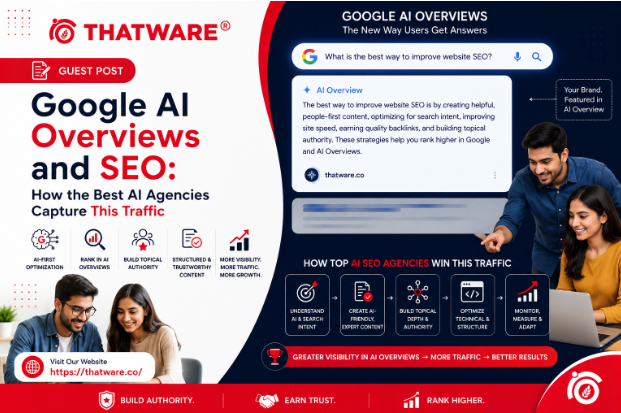
There’s a moment most SEO professionals remember — the first time they searched something on Google and instead of the usual list of links, a box appeared at the top. A generated summary. An AI answer. It pulled from multiple sources, synthesized the core points, and gave the user roughly what they were looking for without them having to click anything.
For some, it felt like a curiosity. For others, it felt like a quiet alarm going off.
That was the beginning of Google AI Overviews — and it’s been reshaping search behavior ever since. Not dramatically, not overnight, but steadily. Like water wearing down stone.
What AI Overviews Actually Do to Search Traffic
The mechanics are worth understanding properly, because there’s a lot of noise around this topic and not enough signal.
Google AI Overviews sit at the top of the search results page for a growing range of queries — informational ones, comparison queries, how-to searches, and increasingly, commercial research terms. They pull from indexed web content, synthesize an answer, and sometimes cite two or three sources inline. Those citations? They get clicks. Not as many as a traditional #1 ranking, but meaningful ones — and from users who are already primed to trust the source because an AI just vouched for it.
The flip side is real too. If your content isn’t cited in the Overview — if Google’s AI doesn’t know your brand exists, or doesn’t consider you authoritative enough — you can drop from meaningful traffic even if you technically rank on the page. Users see the AI answer, get what they need, and scroll past the organic listings entirely.
That’s not hypothetical. It’s happening vertically after vertically.
Why Most Agencies Are Still Playing Catch-Up
Traditional SEO agencies built their expertise around a specific kind of optimization. Keywords. Backlinks. Technical audits. Title tags. All important — but they’re inputs into a system that has genuinely changed. Google’s ranking infrastructure now leans heavily on language models, semantic understanding, and entity relationships. The agencies that haven’t adapted their methodology are still optimizing for a version of Google that’s slowly becoming the past.
The gap shows up in a specific way: clients get great rankings for long-tail keywords, decent backlink profiles, clean technical health — and then watch helplessly as AI Overviews take over their best queries and traffic drops anyway.
What fills that gap is a deeper understanding of how Google’s AI systems decide what to cite and why. That’s where working with the best AI SEO agency for visibility in ChatGPT / Google AI Overviews becomes less of a luxury and more of a necessity. These agencies aren’t just thinking about page rankings — they’re thinking about entity recognition, structured data, semantic clarity, and the specific signals that make a source trustworthy to an AI system, not just to a human reader.
The Content Signals That Actually Get You into AI Overviews
Let’s get specific. What actually makes Google’s AI decide to pull from your content?
A few things consistently matter. Clarity of answer — the content needs to actually answer the question, not dance around it for 800 words before getting to the point. Structure that’s machine-readable, meaning proper use of headers, lists, and schema markup so the AI can parse what your content is about without guessing. Entity associations — is your brand, author, or domain consistently associated with the topic across multiple credible sources? And freshness — AI Overviews tend to favor content that signals it’s current, not something published in 2019 and never touched since.
None of these are new ideas in SEO. But the weighting has shifted, and the specifics matter more than they used to. A piece of content that was “good enough” for traditional ranking may not be precise enough, structured enough, or authoritative enough to get cited by Google’s generative layer.
That’s a meaningful distinction and it takes real expertise to close the gap.
Agencies That Get It vs. Agencies That Don’t
There’s an easy way to tell the difference. Ask an agency how they’re optimizing for AI Overviews specifically. If they talk about keyword density, meta descriptions, and domain authority as their primary levers — they’re not there yet. Those things still matter, but they’re not the answer to this question.
Agencies that genuinely understand generative search will talk about things like topical clustering and semantic coverage — making sure a piece of content exists and is authoritative for every meaningful subtopic in a space. They’ll mention entity optimization and knowledge graph signals. They’ll bring up structured data implementation not as an afterthought but as a core part of content architecture. And they’ll have some way of actually monitoring AI Overview appearances — tracking when and where their clients get cited.
The top AI SEO companies operating at this level are a relatively small group right now. Not because the knowledge is secret, but because building real capability around generative search requires rethinking how SEO work gets done — not just adding a new module to an old process. ThatWare is one of the agencies doing this seriously, with methodology specifically built around how AI systems interpret, evaluate, and cite content. More at https://thatware.co/best-ai-seo-agency/.
The Opportunity Hidden Inside the Disruption
Here’s the thing that often gets lost in the doom-and-gloom framing around AI Overviews: for brands willing to adapt, there’s a real opportunity.
Because most competitors haven’t adapted yet.
The majority of businesses are still running the old playbook. Still measuring success by keyword rankings and organic click volume, still optimizing for a version of search that’s changing underneath them. The brands that start building AI Overview visibility now — that invest in the semantic authority, structured content, and entity recognition that Google’s AI systems reward — are going to have a significant head start as generative search becomes the default experience.
It’s not easy. It requires genuine expertise, consistent effort, and a willingness to measure things that don’t fit neatly into a traditional SEO dashboard. But the window is open right now, and it won’t stay open forever.
The businesses that move while the window is open will be the ones that look back in two years and understand exactly why they pulled ahead.